


Page 107 - Agriculture_Form_3
P. 107
Agriculture for Secondary Schools


              Common pea diseases and their management
              Like other legumes, common peas are affected by several diseases caused by
              fungi or viruses. These diseases attack leaves, stems, roots, or pods, especially
              in wet or poorly drained fields. Early identification and good management help
              reduce damage and improve yields. The most common diseases in Tanzania are
          FOR ONLINE READING ONLY
              described here.
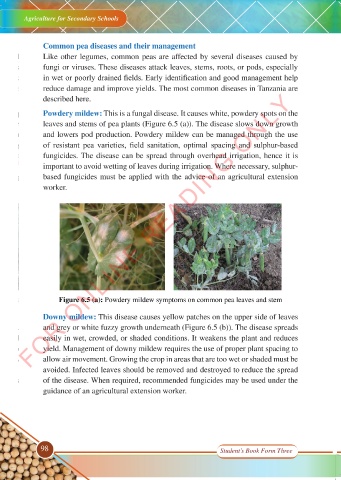
              Powdery mildew: This is a fungal disease. It causes white, powdery spots on the
              leaves and stems of pea plants (Figure 6.5 (a)). The disease slows down growth
              and lowers pod production. Powdery mildew can be managed through the use
              of  resistant  pea  varieties,  field  sanitation,  optimal  spacing  and  sulphur-based
              fungicides. The disease can be spread through overhead irrigation, hence it is
              important to avoid wetting of leaves during irrigation. Where necessary, sulphur-
              based fungicides must be applied with the advice of an agricultural extension
              worker.


                   Figure 6.5 (a): Powdery mildew symptoms on common pea leaves and stem

              Downy mildew: This disease causes yellow patches on the upper side of leaves
              and grey or white fuzzy growth underneath (Figure 6.5 (b)). The disease spreads
              easily in wet, crowded, or shaded conditions. It weakens the plant and reduces
              yield. Management of downy mildew requires the use of proper plant spacing to
              allow air movement. Growing the crop in areas that are too wet or shaded must be
              avoided. Infected leaves should be removed and destroyed to reduce the spread
              of the disease. When required, recommended fungicides may be used under the
              guidance of an agricultural extension worker.


             98                                                     Student’s Book Form Three


                                                                                            17/09/2025   14:12
     AGRICULTURE F3.indd   98                                                               17/09/2025   14:12
     AGRICULTURE F3.indd   98

