


Page 159 - Agriculture_Form_3
P. 159
Agriculture for Secondary Schools


              record keeping, and removing animals which do not perform well (culling). Each
              of these steps helps to plan and manage dairy enterprises.

              Heat detection and flushing
              Cows and heifers should only be bred when they are on heat and according to
          FOR ONLINE READING ONLY
              breeding plans. Signs of heat include a swollen and reddish vulva, clear mucus
              discharge,  loud  bellowing, restlessness,  and  standing  still  to  be  mounted.
              Sometimes, the cow’s appetite drops and milk production decreases for a short
              time. These signs help the farmer to know when to mate the animals on heat or
              call the inseminator for artificial insemination.

              Flushing is a feeding practice done two to three weeks before mating. It involves
              giving extra concentrates to cows and heifers. This improves their body condition,
              makes heat signs clearer, and increases the chance of a successful conception.
              Flushing also helps cows that are weak or have just calved to recover and become
              ready for mating.
              Methods of mating
              There are two main mating methods in dairy cattle, namely, natural mating and
              artificial insemination (AI). Natural mating is when a bull mates directly with the
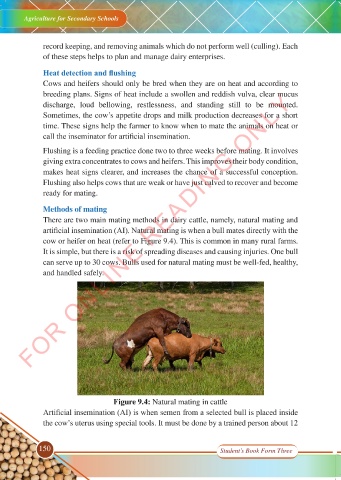
              cow or heifer on heat (refer to Figure 9.4). This is common in many rural farms.
              It is simple, but there is a risk of spreading diseases and causing injuries. One bull
              can serve up to 30 cows. Bulls used for natural mating must be well-fed, healthy,
              and handled safely.


                                   Figure 9.4: Natural mating in cattle
              Artificial insemination (AI) is when semen from a selected bull is placed inside
              the cow’s uterus using special tools. It must be done by a trained person about 12


             150                                                    Student’s Book Form Three


                                                                                            17/09/2025   14:12
     AGRICULTURE F3.indd   150                                                              17/09/2025   14:12
     AGRICULTURE F3.indd   150

