


Page 156 - Agriculture_Form_3
P. 156
Agriculture for Secondary Schools


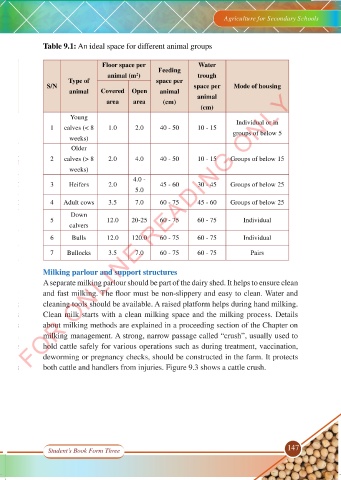
              Table 9.1: An ideal space for different animal groups

                                Floor space per   Feeding    Water
                                  animal (m )                trough
                                          2
                      Type of                   space per
               S/N                                          space per   Mode of housing
          FOR ONLINE READING ONLY
                      animal   Covered  Open     animal      animal
                                 area    area     (cm)
                                                              (cm)
                      Young
                                                                        Individual or in
                1   calves (< 8   1.0     2.0    40 - 50     10 - 15   groups of below 5
                      weeks)
                       Older
                2   calves (> 8   2.0     4.0    40 - 50     10 - 15   Groups of below 15
                      weeks)
                                         4.0 -
                3     Heifers     2.0            45 - 60     30 - 45   Groups of below 25
                                          5.0
                4   Adult cows    3.5     7.0    60 - 75     45 - 60   Groups of below 25

                      Down
                5                12.0    20-25   60 - 75     60 - 75       Individual
                      calvers
                6      Bulls     12.0    120.0   60 - 75     60 - 75       Individual

                7    Bullocks     3.5     7.0    60 - 75     60 - 75         Pairs

              Milking parlour and support structures
              A separate milking parlour should be part of the dairy shed. It helps to ensure clean
              and fast milking. The floor must be non-slippery and easy to clean. Water and
              cleaning tools should be available. A raised platform helps during hand milking.
              Clean milk starts with a clean milking space and the milking process. Details
              about milking methods are explained in a proceeding section of the Chapter on
              milking management. A strong, narrow passage called “crush”, usually used to
              hold cattle safely for various operations such as during treatment, vaccination,
              deworming or pregnancy checks, should be constructed in the farm. It protects
              both cattle and handlers from injuries. Figure 9.3 shows a cattle crush.


                Student’s Book Form Three                                               147


                                                                                            17/09/2025   14:12
     AGRICULTURE F3.indd   147                                                              17/09/2025   14:12
     AGRICULTURE F3.indd   147

