


Page 154 - Agriculture_Form_3
P. 154
Agriculture for Secondary Schools


              environment  for feeding  and milking. A well-designed  housing system saves
              labour and improves the health and safety of animals and their attendants.
              When planning a proper housing system for dairy cattle, consider the: type of
              production system used, nature of the site, key features of a dairy shed, and housing
          FOR ONLINE READING ONLY
              requirements for different groups of animals. Also consider other important areas,
              including the milking parlour, storage spaces, and waste disposal/management
              area. Details for each of these parts are provided in the following sub-sections:

              Housing and dairy production systems
              The type of housing needed depends on the system of dairy production.  For
              intensive systems (zero-grazing) where cattle stay indoors full-time, a complete
              shelter with feed and water troughs, milking area, and waste drainage is required.
              In semi-intensive systems, only a simple night shelter, for example, a kraal, is
              needed. Housing design in each system may vary based on space, breed, animal
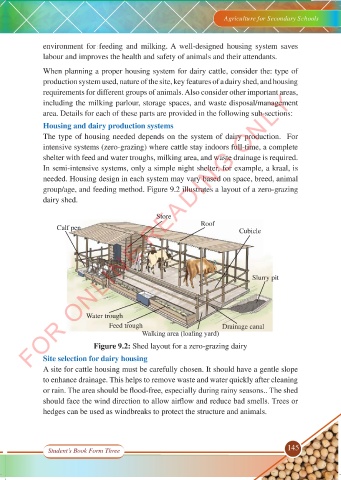
              group/age, and feeding method. Figure 9.2 illustrates a layout of a zero-grazing
              dairy shed.

                                                Store
                                                              Roof
                  Calf pen                                               Cubicle


                                                                             Slurry pit


                           Water trough
                                  Feed trough                       Drainage canal
                                            Walking area (loafing yard)
                             Figure 9.2: Shed layout for a zero-grazing dairy

              Site selection for dairy housing
              A site for cattle housing must be carefully chosen. It should have a gentle slope
              to enhance drainage. This helps to remove waste and water quickly after cleaning
              or rain. The area should be flood-free, especially during rainy seasons.. The shed
              should face the wind direction to allow airflow and reduce bad smells. Trees or
              hedges can be used as windbreaks to protect the structure and animals.


                Student’s Book Form Three                                               145


                                                                                            17/09/2025   14:12
     AGRICULTURE F3.indd   145
     AGRICULTURE F3.indd   145                                                              17/09/2025   14:12

