


Page 149 - Agriculture_Form_3
P. 149
Agriculture for Secondary Schools


              of the day and are confined for additional feeding and protection. The intensive
              system, also called zero-grazing, keeps cattle indoors full-time where feeds and
              water are provided. This system suits small plots of land and is suitable for high-
              yield dairy breeds.
          FOR ONLINE READING ONLY
               Cattle breeds for dairy production

              Different dairy cattle breeds are raised depending on the environment and purpose.
              Generally, there are three main breed types commonly raised in Tanzania: local
              breeds, exotic breeds and crossbreeds. Local  breeds include  Zebu, Sahiwal,
              and Mpwapwa. These breeds are disease-resistant and can survive in hot or dry
              climates. However, they have low milk production potential.
              Exotic breeds have high milk production potential, but they require relatively
              better management.  Examples of exotic breeds are Friesian, Jersey, Ayrshire,
              Brown Swiss, and Guernsey. Crossbreeds combine local and exotic breed traits;
              as a result, they give higher milk yields compared to local breeds while resisting
              diseases better  than  exotic  ones. Crossbreeds are  popular  among  Tanzanian
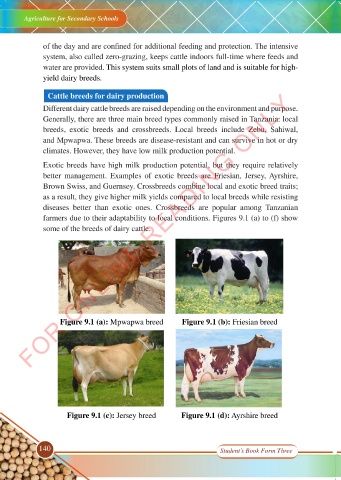
              farmers due to their adaptability to local conditions. Figures 9.1 (a) to (f) show
              some of the breeds of dairy cattle.


                   Figure 9.1 (a): Mpwapwa breed        Figure 9.1 (b): Friesian breed


                     Figure 9.1 (c): Jersey breed       Figure 9.1 (d): Ayrshire breed


             140                                                    Student’s Book Form Three


                                                                                            17/09/2025   14:12
     AGRICULTURE F3.indd   140
     AGRICULTURE F3.indd   140                                                              17/09/2025   14:12

