


Page 144 - Agriculture_Form_3
P. 144
Agriculture for Secondary Schools


              Exercise 8.6
              1.  You find several pigeon pea plants in the field with wilted leaves. What could
                  be the causes of this problem, and how would you manage it?

              2.  Some pods in your school garden have holes and black dust inside. Which
          FOR ONLINE READING ONLY
                  pest might be responsible, and what action(s) would you take?

              3.  During a routine check, you notice white powder on the leaves of healthy-
                  looking plants. What might be the pest or disease, and how will you manage
                  it?

              4.  A pigeon pea farmer plans to re-use seeds from plants that looked healthy but
                  grew in a field where some plants had diseases. What problems could this
                  decision cause in the next season, and how could it be avoided?


               Harvesting, postharvest management and marketing of pigeon pea

              Proper harvesting, postharvest handling, and marketing of pigeon peas reduce
              losses and improve  farmers’ and traders’ income.  These  practices  are  quite
              important in maintaining the quality of the crop for both consumption and sale.
              Each stage must be completed at the correct time to ensure better results.

              Harvesting of common peas
              The time from sowing to harvesting depends on the variety used and growing
              conditions. Early maturing varieties are usually ready after 85 - 120 days. Medium
              to late-maturing varieties may take 150 - 300 days. Pigeon peas are harvested
              either as vegetable peas or as dry grain. The method and timing depend on the
              intended use and market demand.

              Vegetable pigeon peas are harvested when the pods are green, plump, and the
              seeds inside are soft. This usually occurs between 3 and 6 months after planting.
              Harvesting is done by hand and must be repeated every few days as new pods
              continue to mature. In some countries, such as Ethiopia, young pigeon pea leaves
              are also used as vegetables. Dry-grain pigeon peas are harvested when the pods
              turn brown and dry on the plant. At this stage, the seeds inside are hard and
              suitable for long-term storage. The round or oval seeds may be light brown to
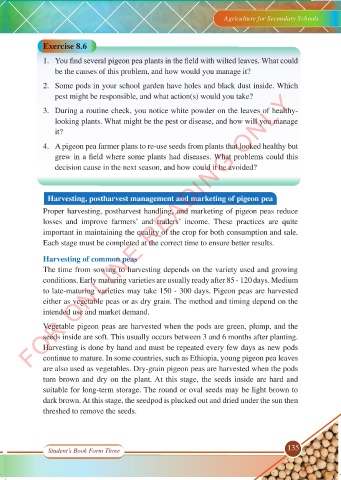
              dark brown. At this stage, the seedpod is plucked out and dried under the sun then
              threshed to remove the seeds.


                Student’s Book Form Three                                               135


                                                                                            17/09/2025   14:12
     AGRICULTURE F3.indd   135                                                              17/09/2025   14:12
     AGRICULTURE F3.indd   135

