


Page 207 - Agriculture_Form_3
P. 207
Agriculture for Secondary Schools


              6.  (a)    Suggest changes or improvements that have to be made to traditional
                       beef production systems in Tanzania?
                  (b)   Explain how these changes would help to increase productivity?


          FOR ONLINE READING ONLY
               Housing for beef cattle

              Beef cattle housing refers to the structures built to confine and protect the animals.
              Proper housing keeps animals safe from predators and harsh weather conditions
              like heavy rain, strong direct sunlight, cold winds and heat. It ensures comfort,
              improves animal welfare, and helps to control diseases and parasites.
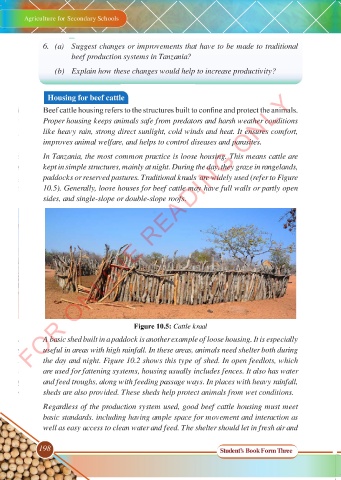
              In Tanzania, the most common practice is loose housing. This means cattle are
              kept in simple structures, mainly at night. During the day, they graze in rangelands,
              paddocks or reserved pastures. Traditional kraals  are widely used (refer to Figure
              10.5). Generally, loose houses for beef cattle may have full walls or partly open
              sides, and single-slope or double-slope roofs.


                                          Figure 10.5: Cattle kraal
              A basic shed built in a paddock is another example of loose housing. It is especially
              useful in areas with high rainfall. In these areas, animals need shelter both during
              the day and night. Figure 10.2 shows this type of shed. In open feedlots, which
              are used for fattening systems, housing usually includes fences. It also has water
              and feed troughs, along with feeding passage ways. In places with heavy rainfall,
              sheds are also provided. These sheds help protect animals from wet conditions.

              Regardless of the production system used, good beef cattle housing must meet
              basic standards. including having ample space for movement and interaction as
              well as easy access to clean water and feed. The shelter should let in fresh air and


             198                                                    Student’s Book Form Three


                                                                                            17/09/2025   14:12
     AGRICULTURE F3.indd   198
     AGRICULTURE F3.indd   198                                                              17/09/2025   14:12

