


Page 210 - Agriculture_Form_3
P. 210
Agriculture for Secondary Schools


              distances in search of water and forage. They may have seasonal migrations. This
              is common in rural areas with large open lands. Feed quality in this system often
              changes with the season and environment. During the rainy season, grasses are
              fresh and full of nutrients. During the dry season, grass becomes dry, scarce, and
              low in nutrients, which can slow animal growth.
          FOR ONLINE READING ONLY
              In the semi-intensive system, cattle graze during the day and may get extra feed
              where they are confined after grazing. This improves their nutrition, especially
              when the pasture is poor. In a semi-intensive system, sometimes land can be
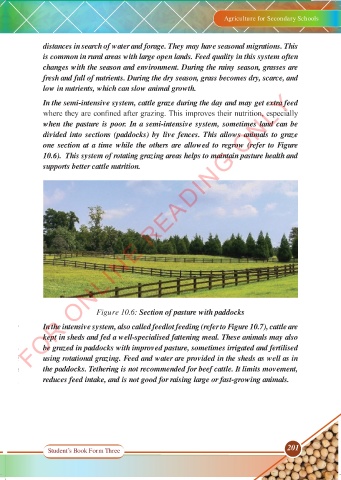
              divided into sections (paddocks) by live fences. This allows animals to graze
              one section at a time while the others are allowed to regrow (refer to Figure
              10.6).  This system of rotating grazing areas helps to maintain pasture health and
              supports better cattle nutrition.


                              Figure 10.6: Section of pasture with paddocks

              In the intensive system, also called feedlot feeding (refer to Figure 10.7), cattle are
              kept in sheds and fed a well-specialised fattening meal. These animals may also
              be grazed in paddocks with improved pasture, sometimes irrigated and fertilised
              using rotational grazing. Feed and water are provided in the sheds as well as in
              the paddocks. Tethering is not recommended for beef cattle. It limits movement,
              reduces feed intake, and is not good for raising large or fast-growing animals.


                Student’s Book Form Three                                               201


                                                                                            17/09/2025   14:12
     AGRICULTURE F3.indd   201                                                              17/09/2025   14:12
     AGRICULTURE F3.indd   201

