


Page 28 - Biology Form Two
P. 28
Biology for Secondary Schools


              The World Health Organisation (WHO)  kilograms, your BMI can be calculated
              recommends the normal levels of BMI  as:        60       60            k
              to be in the range of 18.5-25.4.  BMI is     (1.65) 2  =  2.7225  =  22.04 Kg m 2
              calculated using the following formula:
          FOR ONLINE READING ONLY
                               Body mass              If an individual BMI falls in the range
                    BMI =
                            (Person’s height) 2       of 18.5-25.4, this is considered  to be
                                                      healthy. On the other hand, if the BMI
              Whereby:
                                                      is over 30, one may  be at  risk of
              BMI = Body Mass Index in kg/m   2       diseases associated with obesity.  The
              Body mass = Person’s weight in kg       following table shows a general guide
              Person’s height = Person’s height in m
                                                      of  how different  values  of  BMI are
              For example, if  your height  is 1.65  used  to  define  the  condition  of  the
              metres and your body  mass is 60  body.


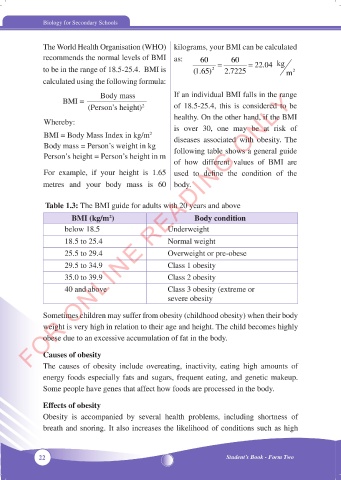
               Table 1.3: The BMI guide for adults with 20 years and above
                       BMI (kg/m )                          Body condition
                                  2
                     below 18.5                     Underweight
                     18.5 to 25.4                   Normal weight

                     25.5 to 29.4                   Overweight or pre-obese
                     29.5 to 34.9                   Class 1 obesity
                     35.0 to 39.9                   Class 2 obesity

                     40 and above                   Class 3 obesity (extreme or
                                                    severe obesity


              Sometimes children may suffer from obesity (childhood obesity) when their body
              weight is very high in relation to their age and height. The child becomes highly
              obese due to an excessive accumulation of fat in the body.

              Causes of obesity
              The causes of obesity include overeating,  inactivity, eating  high amounts of
              energy foods especially fats and sugars, frequent eating, and genetic makeup.
              Some people have genes that affect how foods are processed in the body.


              Effects of obesity
              Obesity is accompanied by several health problems, including shortness of
              breath and snoring. It also increases the likelihood of conditions such as high


             22                                                      Student’s Book - Form Two


                                                                                          05/10/2024   15:36:20
     BIOLOGY FORM 2 NEW.indd   22                                                         05/10/2024   15:36:20
     BIOLOGY FORM 2 NEW.indd   22

