


Page 151 - Theatre_Arts_Form_5
P. 151
Theatre Arts for Advanced Secondary Schools


                (d) Uses of artifacts: Artifacts are objects made by human being and normally
                    reflect life, culture and history of the community. Artifacts require being
                    meaningful to the audience and relevant to the context of the performance.
                    Theatre artists need to be aware of the artifacts they incorporate in their
                    performances.  The artifacts  include  historical  paintings, sculptures,
        FOR ONLINE READING ONLY
                    jewellery and instruments. Appropriate use of artifacts can enrich the
                    performance which consequently fosters a deeper connection with the
                    theme of performance being portrayed. During performances, artifacts
                    can be placed on backdrops or anywhere provided that they are seen by
                    the audience and they relate to the message being communicated. For
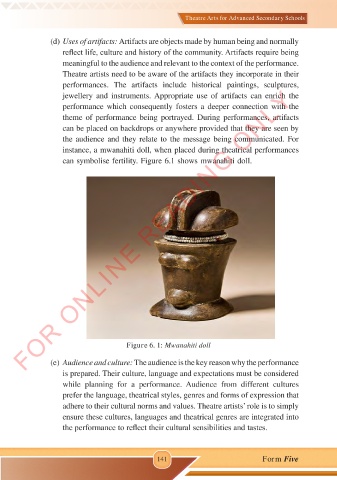
                    instance, a mwanahiti doll, when placed during theatrical performances
                    can symbolise fertility. Figure 6.1 shows mwanahiti doll.


                                      Figure 6. 1: Mwanahiti doll

                (e) Audience and culture: The audience is the key reason why the performance
                    is prepared. Their culture, language and expectations must be considered
                    while  planning for a performance.  Audience  from different  cultures
                    prefer the language, theatrical styles, genres and forms of expression that
                    adhere to their cultural norms and values. Theatre artists’ role is to simply
                    ensure these cultures, languages and theatrical genres are integrated into
                    the performance to reflect their cultural sensibilities and tastes.


                                               141                             Form Five


                                                                                          28/06/2024   15:05
   THEATRE ART F5 fnl.indd   141                                                          28/06/2024   15:05
   THEATRE ART F5 fnl.indd   141

